
Working Capital: The Cultural Side of Cash

The changing conversation about working capital
Working capital has moved firmly up the agenda for most law firms over the past few years. Some firms continue to focus on improving lock-up and accelerating cash conversion. Others have already made significant progress and are now asking a different question: how do we sustain it?
Both are important challenges. Because whether you're trying to improve working capital or protect the gains you've already made, the same principle applies.
Strong cash performance is rarely driven by Finance alone. It is created by the everyday decisions made across the business. When time is recorded promptly, matters are managed proactively, bills are raised at the right time, difficult conversations happen early and client expectations are managed well, cash flows naturally through the business. When those behaviours become inconsistent, working capital begins to drift. Not overnight. Not dramatically. But gradually. That is why the firms with consistently strong working capital rarely see it as a finance metric. They see it as a leadership discipline.
What is really happening?
The latest PwC Law Firm Survey 2025 suggests that many firms are making real progress. Around 63% of firms reported improvements in lock-up, demonstrating that focused leadership attention and operational discipline can deliver meaningful results. At the same time, 70% identified working capital as their highest priority source of funding for business process re-engineering, recognising that strong cash generation creates the capacity to invest in technology, AI and future growth.
Those are encouraging findings. But they also prompt a more interesting question - what separates the firms that make lasting improvements from those that continually revisit the same working capital challenges?
The answer rarely lies in better finance reports or more sophisticated dashboards. It lies in behaviours. The same PwC survey found that 36% of firms experienced unplanned write-offs of 15% or more. That isn't simply a finance statistic. It reflects a series of commercial decisions made throughout the life of a matter.
Were expectations with the client clear from the outset?
Was scope managed effectively?
Were fee discussions held early enough?
Were potential issues identified before they became write-offs?
Working capital is often viewed as a financial outcome. We see it differently. It is one of the clearest indicators of commercial discipline across a partnership.
Every pound tied up in work in progress, every delayed bill and every avoidable write-off is the cumulative result of hundreds of small decisions made every day. That is why firms with similar clients, similar finance systems and similar technology can produce very different cash outcomes. The difference is rarely the process. It is the consistency of the behaviours behind it.
What we learned in operational leadership
Throughout our COO careers, one misconception surfaced time and again. When working capital deteriorated, the instinctive response was often to ask Finance to fix it. But Finance rarely lacked visibility. They knew where matters had stalled. They understood which bills remained unraised. They could identify ageing WIP and overdue debt almost instantly. The challenge was rarely information. It was ownership.
The firms that consistently generated strong cash performance shared a number of common characteristics.
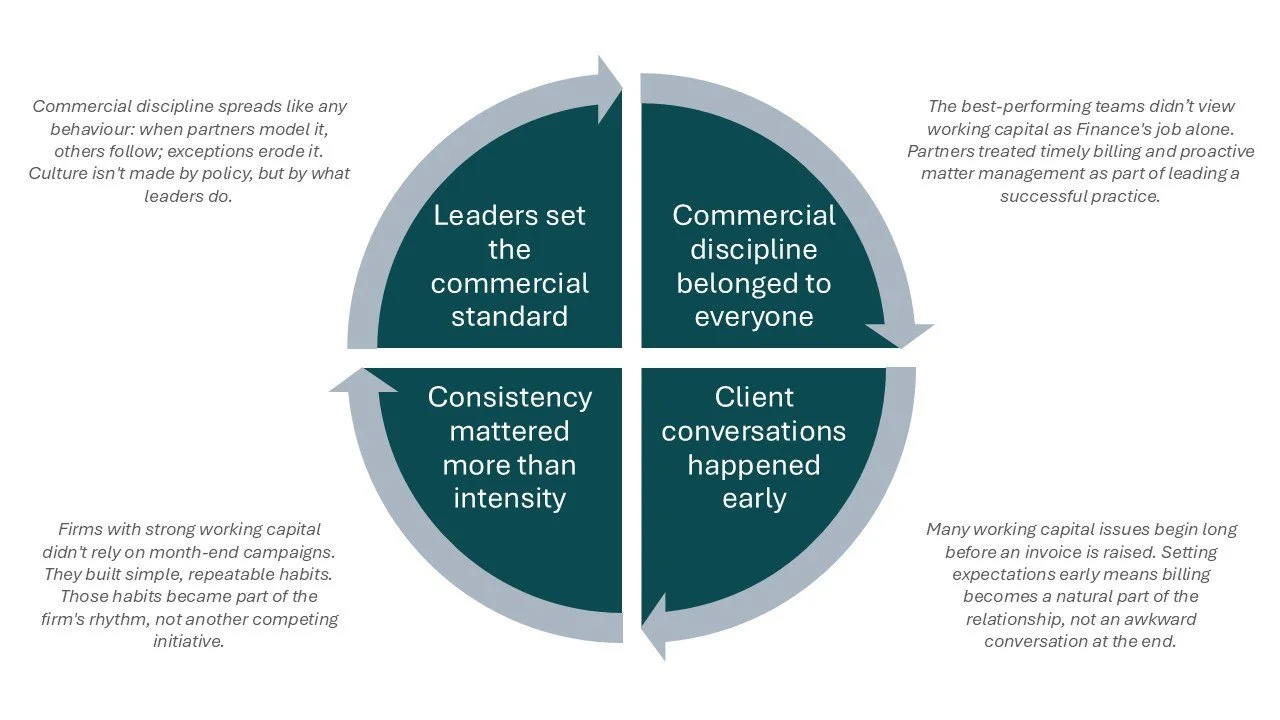
1. Commercial discipline belonged to everyone
The highest-performing firms never viewed working capital as solely Finance's responsibility.
Partners understood that recording time promptly, managing matters proactively, agreeing scope, billing at the right time and resolving queries quickly were all part of leading a successful practice.
Commercial discipline wasn't something delegated after the event.
It was embedded into the way client work was managed from day one.
2. Client conversations happened early
Many working capital issues begin long before an invoice is raised.
Clear conversations about scope, assumptions, fees and billing arrangements create certainty for both the client and the firm. When expectations are established early, billing becomes a natural continuation of the client relationship rather than an uncomfortable discussion at the end of a matter.
3. Consistency mattered more than intensity
The firms that sustained strong working capital didn't rely on month-end campaigns or periodic improvement programmes. They built simple, repeatable habits. Those behaviours became part of the firm's operating rhythm rather than another initiative competing for attention.
4. Leaders set the commercial standard
Commercial discipline spreads in exactly the same way as every other behaviour. When senior partners demonstrated good billing discipline, proactive matter management and timely decision-making, others followed. When exceptions became commonplace, standards gradually slipped.
Culture isn't created through policy. It's created by what leaders consistently do.
Practical actions for leadership teams
Working capital creates far more than healthy cash flow. It creates strategic flexibility.
The PwC Law Firms' Survey 2025 found that 70% of firms see working capital as the primary source of funding for business process re-engineering. That matters because firms are facing significant investment decisions around AI, technology, client experience and talent.
The firms best placed to make those investments are often not only those generating the highest profits. They are also the firms consistently converting those profits into cash.
Strong working capital provides options. It enables firms to invest proactively rather than reactively. In an increasingly competitive market, that flexibility becomes a genuine strategic advantage.
Sustainable improvement comes from strengthening the leadership disciplines that shape commercial behaviour across the firm.
For leadership teams, five actions are worth considering.
1. Position working capital as a leadership responsibility
The strongest-performing firms don't see working capital as a finance issue. They recognise that every partner, practice leader and matter manager influences cash performance through the decisions they make every day. Creating that shared ownership is the foundation for lasting improvement.
2. Reinforce the commercial behaviours that drive cash
Strong cash performance is built long before an invoice is raised. Leaders should regularly reinforce the behaviours that matter most: agreeing scope early, recording time promptly, reviewing matters proactively, billing at the right time and resolving client queries quickly. These may appear to be operational disciplines, but together they have a significant impact on financial performance.
3. Make working capital part of everyday leadership conversations
Working capital should not only be reviewed at month-end or when performance deteriorates. The most effective firms embed it into routine leadership discussions alongside client service, people, profitability and business development. When commercial performance becomes part of the firm's operating rhythm, improvement is far more likely to be sustained.
4. Use cash to create strategic flexibility
Strong working capital is not simply about improving liquidity. It creates the capacity to invest confidently in technology, AI, talent and future growth without placing unnecessary pressure on profitability. Leadership teams should therefore view cash generation not as an end in itself, but as an enabler of strategic choice.
5. Lead by example
Commercial discipline starts with leadership. When senior partners demonstrate good matter management, timely billing, proactive client conversations and strong commercial judgement, they set the standard for others to follow.
However, culture is shaped by more than the behaviours leaders demonstrate. It is equally shaped by the behaviours they are prepared to tolerate. If agreed standards are applied inconsistently, or if repeated exceptions are ignored without challenge, people quickly learn what the organisation truly values. Over time, those exceptions become accepted ways of working.
The strongest firms create clear expectations, reinforce them consistently and address behaviours that undermine the firm's commercial ambitions. Leadership is defined not only by the example it sets, but also by the standards it is prepared to uphold.
Questions for leadership teams
Does your partnership see working capital as a Finance responsibility or a leadership responsibility?
Which partner behaviours have the greatest influence on your firm's cash performance?
Where are avoidable delays introduced into the lifecycle of a matter?
Are commercial conversations happening early enough with clients?
Are your current behaviours sufficient to sustain the progress you've already made?
Key takeaways:
Working capital performance is shaped far more by everyday partner and fee‑earner behaviours than by finance processes. Cash improves when commercial discipline is embedded into matter management from day one.
The biggest gains come from early, confident client conversations about scope, assumptions, fees and billing - reducing write‑offs and making billing a natural continuation of the relationship.
Sustained improvement depends on consistency, not campaigns. Firms with strong cash performance build simple, repeatable habits that become part of the operating rhythm.
Leadership sets the commercial standard. When partners demonstrate timely billing, proactive matter management and clear decision‑making, those behaviours spread across the firm.
Strong working capital creates strategic flexibility - giving firms the capacity to invest in AI, technology, talent and growth without putting pressure on profitability.
Enjoyed this insight?
At Opal Advisory, we work with leadership teams across professional services to turn strategy into measurable performance. If this article resonates with the challenges your firm is facing, we'd be delighted to continue the conversation.