
Why the billable hour isn’t the enemy - but unmanaged capacity is.

The familiar moment
A Managing Partner looks at the monthly dashboard and sees the same pattern again. Fee income is broadly on track, but chargeable hours are drifting. Senior lawyers are carrying more spare capacity than anyone expected. Partners insist they’re “flat out”, yet the numbers tell a different story.
The leadership team debates whether to push harder on utilisation targets, but no one wants to trigger a backlash. Someone suggests a pricing review. Someone else mentions AI. The conversation becomes wider and strangely familiar - lots of ideas, little clarity, and no single lever that feels decisive.
Everyone leaves the room knowing productivity is the issue. No one leaves with a plan.
For as long as we have worked in law-firm operations, productivity and chargeable hours have been among the most persistent leadership conversations. They are also among the easiest conversations to get wrong.
When performance comes under pressure, the instinct can be to focus on the headline metric: ask people to record more time, push utilisation targets harder, or issue another reminder about billing. But most lawyers are already working hard. If the answer is simply “do more”, firms risk creating frustration, fatigue and the impression that performance is being reduced to a number.
What is really happening
The billable hour is not the problem. The real issue is unmanaged capacity - and the structural, behavioural and leadership choices that create it.
The PwC Law Firm Survey 2025 shows the pattern clearly:
Chargeable hours are falling across senior grades (Top 10 fixed‑share partners down 8.6%, 9+ PQE down 8.3%)
Spare capacity is rising (up to 16.3% in Top 51–100 firms)
Fee income growth is being driven by rate increases, not hours
AI is expected to compress hours by 16%, intensifying pressure on utilisation models
For firms ranked 26–50, the pressure is particularly visible. The same survey reports a staff-cost ratio of 46.3% and a profit margin before full equity partner remuneration of 24.3% in 2025. Those figures do not call for indiscriminate cost-cutting. They do call for a clear-eyed view of how the firm deploys its people and where leaders should focus their attention.
Productivity is a system, not an individual trait
A lawyer can be exceptionally committed and still lose significant productive capacity through the way work is organised.
Common causes include unclear matter plans, work sitting too long with the wrong level of fee earner, slow delegation, avoidable rework, poor scoping, delays in review, fragmented technology, under-recorded time and uncertainty about what should be charged. None of these are solved by telling people to work harder.
They are leadership and operating-model questions.
This is particularly relevant as firms adopt generative AI. Thomson Reuters’ 2025 research found that 26% of law-firm professionals were using GenAI at work, up from 14% in 2024, and 45% of law-firm respondents either already use GenAI or expect it to become central to their workflow within a year (see Thomson Reuters Institute, 2025 Generative AI in Professional Services Report). The opportunity is real, but the research also points to the need for strategy, policies, training and client conversations alongside technology adoption. .
“The adage that people + technology gets the best results isn’t only true for the use of GenAI tools, it’s true for implementing them as well. Although many professionals agree that GenAI will become a part of their daily lives, actually adjusting how they work on a daily basis to accommodate it is easier said than done.”
AI also represents a significant investment and firms will be expecting to see a return. If AI investment costs increase while productivity fails to improve, firms risk eroding rather than enhancing profitability.
The leadership question is not simply whether a tool can save time. It is what happens to that time. Does it improve client service? Create capacity for higher-value work? Reduce pressure on teams? Support growth? Or disappear into an operating model that has not changed?
This is the new reality. As AI reshapes the economics of professional services, hours become a weaker lever and productivity becomes a far more sophisticated leadership discipline.
Productivity now sits at the intersection of Utilisation, Realisation, Partner behaviour, Structural choices and Technology adoption:
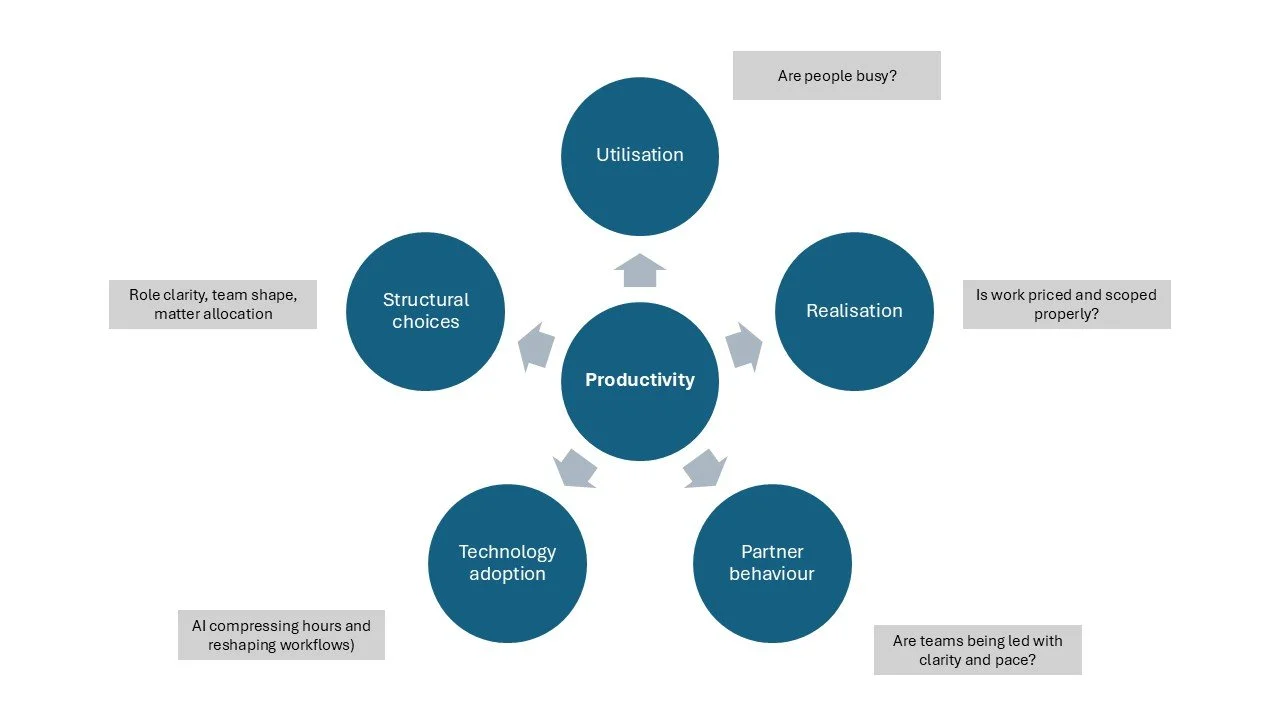
When firms treat utilisation as a standalone number, they miss the system. When they treat productivity as “just bill more hours”, they miss the point entirely.
What we learned in operational leadership
Across our COO roles, productivity was the lever we had to pull every single year. It was never easy - but it was always possible when leadership aligned around a small number of decisive actions.
The highest utilisation we achieved in our practice areas was 6.5 - significantly above the rest of the UK business and a benchmark that held consistently. It didn’t happen by accident.
It happened because we:
Maintained consistent focus - utilisation was one of a small number of strategic priorities that we returned to repeatedly. It remained visible, was regularly discussed and consistently reinforced, rather than becoming one of dozens of competing initiatives.
Secured partner sponsorship - not through dashboards, but through quality time explaining what hitting (and missing) targets meant for them and their teams. We were clear about why it mattered: not simply because higher utilisation improved a metric, but because sustainable performance created the capacity to invest. It supported stronger profitability, better pay reviews, promotions, technology and the ability to build a better platform for people and clients. Partner sponsorship is not achieved through a leadership-team decision or a slide in a quarterly update. It is built through conversation, clarity and visible ownership.
Aligned KPIs and consequences - utilisation wasn’t a number on a report; the message was reinforced through the way the business was run: through KPIs and dashboards, but also through pay, promotion and performance conversations.
Set clear exceptions early - carve‑outs existed, but they were defined upfront, not negotiated endlessly. Where exceptions were needed, they were agreed and communicated early. That avoided the corrosive cycle of repeated debate about why one individual or team should be treated differently.
Took tough decisions - and explained them across the whole business so people understood the rationale. Explaining the rationale across the business matters as much as making the decision. People do not need to agree with every decision to understand that it has been made thoughtfully and applied fairly.
The biggest lesson? Sustainable improvement comes from focus, not complexity. Productivity improves when leaders concentrate on the two or three levers that genuinely move performance and resist the temptation to tackle everything at once.
Practical actions for leadership teams
1. Find the few constraints that matter most
Avoid launching a broad “productivity programme” that tries to fix everything at once.
Start with the evidence: utilisation by team and level, matter profitability, write-offs, WIP ageing, billing patterns, workflow bottlenecks and the lived experience of partners and fee earners. Then identify the two or three constraints that are genuinely limiting performance.
In one area, the answer may be delegation. In another, it may be an unhelpful incentive that rewards activity rather than value.
The point is to really focus on the levers that will move the needle.
2. Make the commercial story meaningful
Targets rarely create commitment on their own.
People need to understand the link between their day-to-day choices and the wider health of the firm: investment in people, technology, client service, career opportunity and the ability to manage pressure more sustainably. People also need to experience the benefits first-hand. When teams achieve the targets that have been set and can see the resulting investment, opportunities or improvements, it reinforces confidence in the approach. Success creates belief, and belief builds momentum for the next cycle of improvement.
That does not mean pretending every commercial message will be universally popular. It means treating people as adults, being honest about the choices the firm faces and explaining the rationale consistently.
3. Align measures, ownership and consequences
“You get what you measure” is only half the story. You get what leaders consistently pay attention to, what they ask about in performance conversations, and what they reinforce through decisions on reward, progression and accountability.
A useful dashboard is not a long list of metrics. It is a small number of measures with clear owners, a shared understanding of what good looks like and an agreed response when performance is off track.
That response should not always be punitive. It may involve support, capability building, workload rebalancing or changes to process. But it should be real. If the same issues appear month after month without action, people quickly learn that the measures are not important and pay less attention to them.
Without consequences, utilisation becomes a polite suggestion.
4. Manage capacity deliberately — not reactively
Unmanaged capacity is expensive. Create a monthly rhythm where partners review:
who has spare capacity
which matters need support
where work can be rebalanced
where structural issues (team shape, seniority mix) are creating drag
This is where restructures may be required. They are not HR events, they are productivity interventions. When done with clarity and pace, they unlock utilisation, strengthen teams and protect culture.
Questions for the leadership team
Where is valuable capacity being lost today: demand, delegation, workflow, time recording or something else? and what is it costing us?
Do we treat productivity as a system or as a single number?
Have we explained the commercial and personal case for change?
What partner behaviours are enabling or constraining productivity?
Are consequences aligned?
Key takeaways:
The real productivity risk is unmanaged capacity - hidden in matter planning, delegation, workflow and partner habits - not the billable hour itself.
Structural issues, not effort, determine how much productive time is lost. Leaders must fix the system, not push people to work harder.
AI will compress hours further, making it essential for partners to redirect saved time into higher‑value work, better client service and sustainable growth.
Improvement comes from focusing on the few constraints that genuinely matter - not launching broad productivity programmes that try to fix everything at once.
Utilisation only becomes meaningful when leaders manage capacity deliberately, reinforce expectations consistently and apply real consequences when performance drifts.
Enjoyed this insight?
At Opal Advisory, we work with leadership teams across professional services to turn strategy into measurable performance. If this article resonates with the challenges your firm is facing, we'd be delighted to continue the conversation.