
The Margin Challenge: Why Sustaining Profitability Has Become Harder

The Changing Conversation About Profitability
Over the past five years, many UK law firms have delivered impressive financial performance. Revenue has grown. Firms have successfully increased hourly rates, strengthened working capital and improved financial resilience. According to the PwC Law Firm Survey 2025, 95% of the UK's Top 100 firms reported fee income growth.
Those achievements deserve recognition. However, the conversation in leadership teams is beginning to change. The challenge is no longer simply how to grow revenue. It is how to continue growing sustainably whilst protecting profitability and creating capacity to invest for the future.
The commercial environment has become more demanding. People costs continue to rise. Investment in AI, cyber security and technology has shifted from discretionary to essential. Regulatory requirements continue to increase. Professional indemnity insurance remains a significant cost pressure.
At the same time, clients are becoming increasingly sophisticated buyers, expecting greater efficiency, transparency and demonstrable value.
Taken together, these pressures are making sustainable profitability harder to achieve than it has been for many years.
What Is Really Happening?
For many firms, protecting margins has relied on a familiar combination of commercial levers: revenue growth, increased hourly rates, improving productivity, stronger working capital and disciplined cost management.
Those levers remain important. However, leadership teams are beginning to recognise that maintaining profitability is becoming more complex. The easy gains have largely been realised. Future improvements are less likely to come from one significant initiative and more likely to depend on lots of better decisions made consistently across the business.
At the same time, AI is beginning to reshape the commercial landscape. While the billable hour remains the dominant pricing model across much of the legal sector, technology is changing how work is delivered and increasing client expectations around efficiency and value.
This does not mean firms need to abandon existing pricing models overnight. It does mean leadership teams should begin asking new strategic questions. If technology enables work to be completed more quickly, how will clients expect that benefit to be shared? How should firms demonstrate value when elapsed time becomes a less reliable measure of it? How should pricing strategies evolve over time?
These questions may not require immediate answers, but they are becoming increasingly important board-level conversations that firms cannot afford to ignore.
Ultimately, this is about far more than pricing. It is about the future of profitability itself. As AI, client expectations and new ways of delivering professional services continue to evolve, leadership teams will need to think differently about the relationship between productivity, value and margin. The commercial conversation is changing and the firms that adapt earliest are likely to be those best placed to sustain profitable growth over the next decade.
What We Learned in Operational Leadership
During our operational careers, we were responsible for leading significant performance improvement programmes across large professional services firms. Perhaps most notably, before leading the integration of what became the UK's second largest law firm merger, we developed the commercial business case that defined what success would look like. One objective sat firmly at its centre. Improve profitability while protecting client relationships and creating capacity for future investment.
Looking back, one lesson stands out. We did not achieve that outcome through one transformational initiative. We achieved it through a series of connected commercial and leadership decisions, executed consistently over time. Several principles proved particularly important.
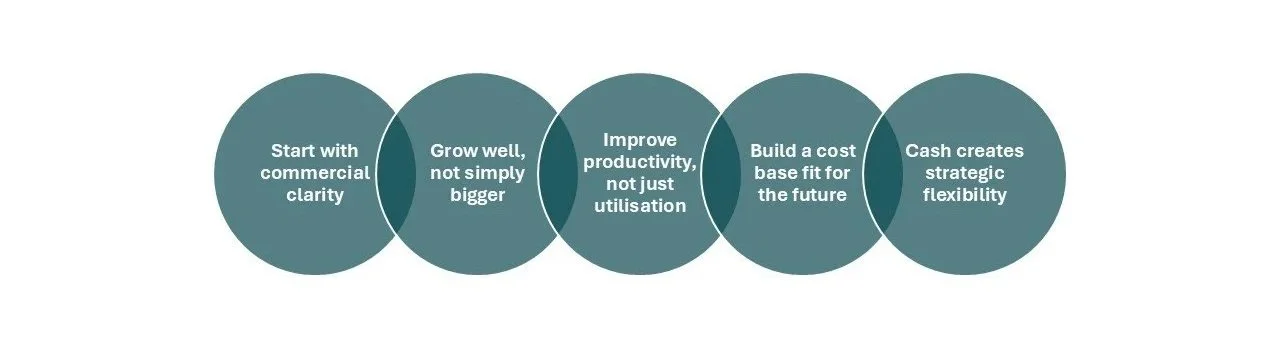
1.Start with commercial clarity
Successful improvement programmes begin with a shared understanding of what success looks like.
Not simply increasing profit, but defining the outcomes the business is trying to achieve: sustainable revenue growth, healthy margins, strong cash generation, investment capacity and client retention.
When leadership teams align around these objectives, decision-making becomes more consistent.
2.Grow well, not simply bigger
Growth only strengthens a firm when it improves profitability. That requires a clear view of which clients, matters and practice areas consistently generate value - and which quietly erode it.
Leadership teams should regularly analyse the lowest‑profit work and understand why it underperforms. In our COO roles, this was one of the most revealing exercises we undertook. We identified the clients with the weakest margins, traced the drivers behind them - pricing, scope creep, leverage, partner behaviours, delivery model - and made deliberate decisions about how to change the trajectory.
Sometimes the answer was to reset expectations with the client. Sometimes it was to redesign the delivery model. And occasionally, it meant making difficult choices about whether certain work should continue at all.
None of those conversations are easy. But they are essential if a firm wants to grow well rather than simply grow bigger. Without clarity on where profit is being diluted, leadership teams risk investing time, talent and capacity into areas that quietly pull the business backwards.
The firms that grow most successfully are those that confront this reality, act decisively and align their growth ambitions with the work that genuinely strengthens the firm.
3.Improve productivity, not just utilisation
Throughout our integration programme, productivity was a constant focus. Not because we expected people to work harder. Because we believed the business could work smarter.
We simplified processes, strengthened accountability, improved delegation and focused leadership attention on the activities that genuinely created value.
Today, AI presents another significant opportunity to improve productivity. However, technology alone never delivers commercial benefit. Leadership determines whether improved productivity becomes improved profitability.
4.Build a cost base fit for the future
Protecting margins also required difficult decisions. We challenged long-standing assumptions, reviewed investment priorities and ensured the firm's cost base reflected the future business rather than the legacy organisation.
Sustainable profitability depends on making deliberate choices about where to invest and where not to.
5.Cash creates strategic flexibility
Improving working capital was one of the key priorities during our integration programme.
Rather than trying to improve every aspect of working capital simultaneously, we focused particular attention on work in progress (WIP), recognising that it represented one of the greatest opportunities to improve both cash generation and profitability for our business.
That focus wasn't simply about reducing lock-up. It required partners and teams to manage matters more proactively, resolve issues earlier, make timely commercial decisions and maintain greater discipline throughout the client lifecycle.
The results were significant. Within the first twelve months, we had made substantial inroads into reducing WIP, strengthening cash generation and improving commercial performance.
More importantly, the improvements created strategic flexibility. Healthy cash flow gave the firm greater capacity to invest in integration, technology and future growth without placing unnecessary pressure on profitability.
Working capital was therefore far more than a finance metric. It became a strategic enabler of our future ambitions.
Practical Actions for Leadership Teams
Protecting margins is not about finding one initiative capable of offsetting rising costs. It requires leadership teams to make deliberate, connected decisions across every part of the business.
Five actions are particularly important:
1. Define what profitable growth really means
Ensure the leadership team has a shared view of what commercial success looks like beyond simply increasing revenue. Growth, profitability, cash generation, investment capacity and client value should reinforce one another, not compete for attention.
2. Challenge whether today's growth is strengthening tomorrow's business
Regularly review whether new work, new clients and new investments are improving long-term profitability. Sustainable growth should strengthen the quality of the business as well as its size.
3. Turn productivity gains into commercial value
Technology and AI can create significant productivity improvements, but those gains only improve margins when leaders redesign processes, clarify accountability and embed new ways of working. Leadership, not technology, determines whether efficiency translates into profitability.
4. Start preparing for the next commercial conversation
The billable hour is unlikely to disappear, but AI is changing how clients think about value. Leadership teams should begin exploring how pricing strategies, client conversations and commercial models may need to evolve over time, rather than waiting for the market to force the discussion.
5. Reinforce the commercial behaviours that protect margin
Strong financial performance depends on consistent leadership. Leaders set the standard through the decisions they make, the behaviours they model and the priorities they reinforce. Equally important is what they choose to tolerate.
If commercial disciplines are applied inconsistently, or repeated exceptions go unchallenged, people quickly learn what the organisation truly values.
The strongest firms create clear expectations, reinforce them consistently and address behaviours that undermine their commercial ambitions.
Questions for Leadership Teams
Are we growing revenue in the areas that will strengthen long-term profitability?
Where are margins quietly eroding across our client lifecycle?
Are we investing in AI with a clear commercial return in mind?
Are we equipping partners to have confident conversations about value and pricing?
Does our cost base reflect the business we are becoming - or the business we used to be?
Which commercial behaviours are we consistently reinforcing—and which are we unintentionally allowing to continue?
Key takeaways:
Sustaining profitability now depends on hundreds of leadership decisions made consistently across the business - not one decisive commercial lever.
Rising people costs, essential investment in AI and technology, and more sophisticated client expectations are reshaping the economics of legal services and making margin protection harder.
Growth only strengthens a firm when it improves profitability. Leaders must understand where margins are quietly eroding across clients, matters and practice areas - and act decisively.
Productivity gains only translate into stronger margins when leaders redesign processes, clarify accountability and embed new ways of working, rather than relying on technology alone.
Strong working capital creates strategic flexibility, enabling firms to invest confidently in technology, talent and future growth without placing pressure on profitability.
Enjoyed this insight?
At Opal Advisory, we work with leadership teams across professional services to turn strategy into measurable performance. If this article resonates with the challenges your firm is facing, we'd be delighted to continue the conversation.