
The Delivery Engine: Why People, Process and Structure Determine Performance

The Changing Conversation About How Work Gets Done
In the previous four articles, we explored the levers of performance: productivity, working capital, profitable growth and the partner behaviours that close the execution gap. This final article turns to the foundation beneath them all - the firm’s delivery engine.
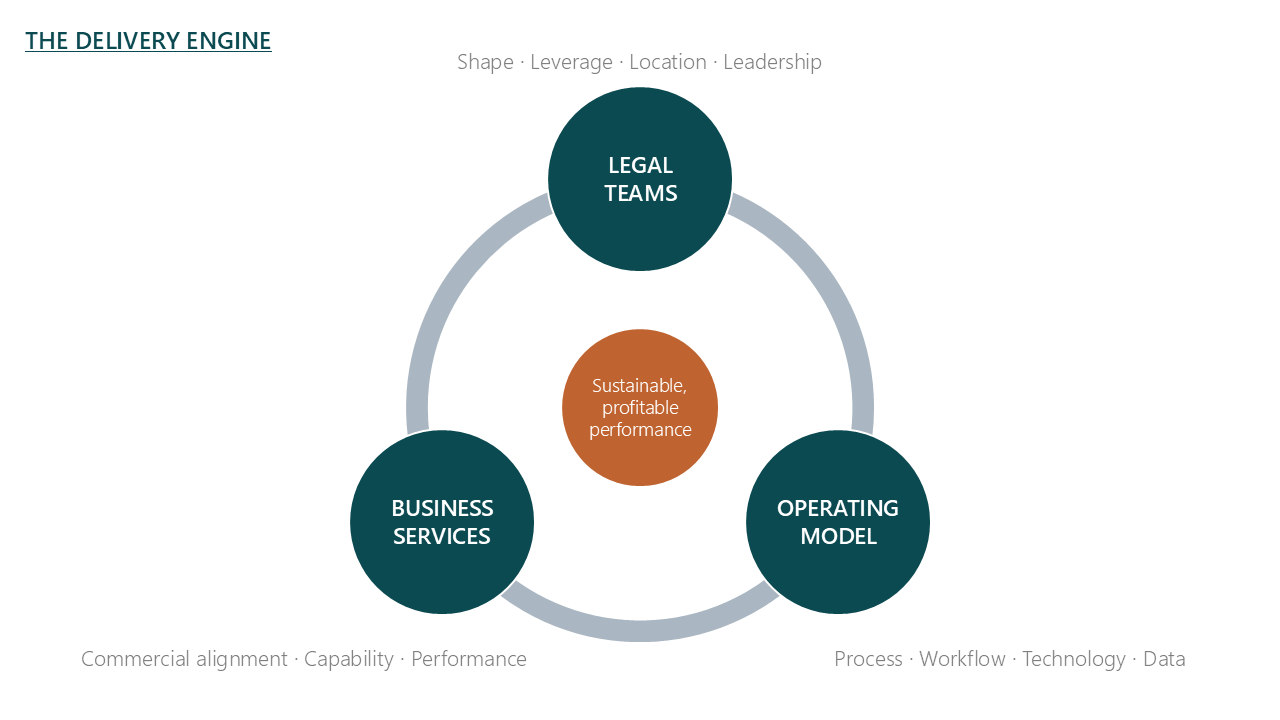
That engine is made up of three interconnected parts: legal teams, the operating model and Business Services. When these three elements are optimised and work coherently, performance accelerates. When one drifts or becomes misaligned, the whole engine loses power.
That engine has always mattered. It matters even more now.
Leadership teams are increasingly recognising that headline growth is no longer enough to outrun deeper operational weaknesses. Firms see their profitability come under pressure while carrying rising salary costs, weak utilisation, poor leverage and expanding overheads.
AI adds further urgency. PwC’s Law Firm Survey 2025 reports that firms expect an average 16% of hours to be saved through AI adoption. Meanwhile AI is expected to have a profound impact on legal operating models and business services processes. All of this change will demand a fundamental reconsideration of the shape and structure of legal and support teams. AI will not fix a weak delivery engine. It will expose it.
Legal teams will need to think differently about shape, leverage, supervision and the talent pipeline. If parts of junior work are automated or augmented, firms must be more deliberate about how capability is built and how future leaders are developed.
Operating models will also be tested. AI improves efficiency only where work is sufficiently understood. Repeatable processes, predictable workflows, reliable data and clear ownership become the foundation for using technology well.
Business Services face the same challenge. HR, finance, marketing, knowledge and risk will all need to decide what should be automated, what should be augmented and where human judgement, commercial influence and partner engagement matter most.
But AI is not the whole story. The more immediate issue is still whether the firm’s people, processes and support functions are aligned to the way the business needs to perform. A weak delivery engine was already costly. AI simply makes the weakness harder to ignore.
When the three elements drift, the impact is rarely dramatic at first. It appears in quieter ways - bottlenecks that weren’t there before, outcomes that fall short of what the business needs, decisions that take longer than they should. Partners feel the drag but struggle to pinpoint the cause.
The problem is rarely visible on a dashboard. It sits in the gaps between people, process and structure - and becomes harder to fix precisely because everything is interconnected.
This is the familiar position for many leadership teams. They know performance is not fully optimised, but the issue feels too vague or too broad to tackle. In a risk-averse profession, the safest option often becomes the status quo.
That is becoming harder to justify.
What Is Really Happening
Beneath the surface of most firms, the delivery engine drifts over time. Not dramatically. Not visibly. But gradually - in ways that quietly erode performance. In our COO roles, we repeatedly saw three patterns:
i. Legal teams drift out of shape
Teams rarely stay perfectly geared. A structure that worked five years ago slowly becomes misaligned. People become more senior. They are valued colleagues and strong performers - but the work has not changed with them. The team no longer “fits” the work. Wage inflation may have outpaced rates, and a model that was comfortably viable three years ago becomes only just viable today, with little prospect of remaining viable three years from now. But because the platform is not visibly burning, the instinct is to leave it.
ii. The operating model fragments
Processes rarely degrade in an instant. One partner prefers one approach, another retains a process inherited from a previous firm, while another believes their work is too bespoke to standardise. Over time, the firm develops a patchwork of approaches sitting under a single brand. Business Services adapt their activities to fit around each partner’s preferences. It just about works - but it’s not consistent, scalable or efficient. The result is a firm with processes, but not one process. Systems, but not one operating model. Data, but no clear way to harness its value.
iii. Business Services become disconnected from the business
In many firms, Business Services operate one step removed from the partnership. Business Services leaders are not always invited to the partner conferences. Strategy messages are directed primarily at lawyers. Over time, disconnected support teams design processes that unintentionally conflict with legal priorities. Some functions grow larger without a clear link to improved performance, and the disconnect means partners sometimes undervalue work they cannot see or connect to commercial impact. The disconnect becomes cultural: Business Services run their own priorities, partners run theirs, and the delivery engine loses coherence.
The leadership dilemma
Leaders can feel the inefficiency. They can sense the drag. They know the delivery engine is not running as smoothly as it could. But diagnosing the problem is difficult because everything is interconnected.
Team shape affects delegation. Delegation affects workflow. Workflow affects process. Process affects Business Services. Business Services affect partner behaviour. Partner behaviour affects everything.
The complexity makes the problem feel too big to touch. In a profession that prizes caution, it becomes easier to delay difficult decisions than to confront them.
What We Learned in Operational Leadership
Changing the delivery engine is hard. It affects people, structure, process, culture and commercial performance. It touches every partner. And it rarely comes with a single, neat solution.
Across our COO careers, we learned that progress was always possible - but only when leadership aligned around a small number of clear priorities, and applied a consistent set of principles to deliver them.
Clarity before action
The first mistake many firms make is trying to overcome problems before defining the destination. In our experience leaders often think first about the obstacles they’ll face when delivering change – cost, partner resistance, disruption - without focusing first on what the future delivery engine needs to look like.
Everything becomes easier once the target outcome is clear. Clarity creates direction. It helps leaders sequence the work, make trade-offs and decide how to tackle the hurdles. Without it, change becomes reactive rather than deliberate.
Governance must empower those leading the change
In a partnership, change cannot always rely on polite consensus. It requires a governance framework that is visibly empowered to act - with clear mandates, senior sponsorship and consistent leadership backing.
Individual partners will not always like the decisions that affect their teams or their ways of working. That is inevitable. What matters is that those leading the change are credible, aligned and supported - and that the decisions are made in the interests of the partnership, not any one individual.
Communication matters too: explain the rationale, engage influential partners early and be transparent about why difficult change or people decisions are necessary.
There is rarely only one solution
Delivery engine problems often feel binary - restructure or don’t restructure, relocate or don’t relocate, centralise or decentralise. In reality, we found that there are often multiple paths to the same broad outcome, and the order in which you tackle them matters as much as the ambition behind them.
Sometimes a team doesn’t need a disruptive restructure; it needs a gradual shift in gearing supported by natural attrition. Sometimes a location strategy can evolve over time rather than change overnight. The key is to balance the competing pressures of urgency, business readiness and the complexity of what you are trying to achieve.
Business Services must be part of the solution
The delivery engine cannot be redesigned by lawyers alone. In our COO roles, we learned that Business Services teams contributed most when time was invested in helping them understand the business: what drove performance, how partners made money, and how their own work affected commercial outcomes. When their activities and objectives were aligned to those priorities, and when they felt informed and valued, their impact increased significantly. They became active agents of change, not simply recipients of decisions made elsewhere.
Pick your battles – and stay the course
Some decisions are difficult: restructures, role changes, capability gaps, performance issues. Partners often avoid them because they’re uncomfortable or politically sensitive. But delivering “half a solution” creates twice the long-term disruption. A partial restructure is 100% unsettling but only 50% effective, and returning to it a year later to deal with the remainder is worse for everyone.
We learned that honesty, clarity and fairness matter far more than trying to soften every message. People prefer difficult truth to vague reassurance.
Practical Actions for Leadership Teams
Reshaping the delivery engine requires deliberate leadership. It is not a single initiative, nor a one-off restructure. It is a series of connected decisions that strengthen how people, processes and structures work together.
1. Define the delivery engine you want - before you try to fix the one you have
Begin with clarity. Agree what the future needs to look like - team shape, workflow, operating model, Business Services alignment - and use that clarity to guide every decision.
2. Build an empowered governance framework that can actually deliver change
Change requires visible sponsorship, clear mandates and consistent leadership backing. Engage influential partners early to build momentum.
3. Sequence change deliberately - and resist the temptation to fix everything at once
Team shape, process, technology and culture are interconnected - but it’s almost impossible to fix them all simultaneously. Take the time to plan and determine the right sequence for the specific issues you are trying to address. When changing processes, start by being clear about what the process is trying to achieve. Then simplify in manageable steps rather than trying to optimise everything at once. Quick wins build confidence; over-engineering kills momentum.
4. Develop leaders, not just lawyers
Start today to future-proof your model. An efficient, optimised delivery engine depends on leadership capability – effective delegation, workflow management, commercial judgement, team development. Build these core leadership skills throughout the career pathway of your lawyers. Promotion should require evidence of leadership competence and a firm-first mindset, not just technical excellence.
5. Align Business Services to the firm’s commercial priorities - and make them part of the solution
Business Services should be embedded in the firm’s strategy, with their functional priorities aligned to it. Ensure they understand the economic drivers of the business and are held to meaningful performance metrics.
Questions for Leadership Teams
Where are we tolerating an economically weak model because changing it feels harder than living with it?
Are our legal teams shaped for the work we deliver today, or for the work we delivered five years ago?
Is our operating model genuinely consistent, or a patchwork of partner-specific approaches?
Do Business Services understand the firm’s commercial priorities? Are they embedded in the business and held to meaningful performance metrics?
Key takeaways:
A strong delivery engine depends on three things working together: the shape of legal teams, the operating model and Business Services. When one drifts, performance suffers.
AI will expose weaknesses rather than solve them. Firms need clear workflows, appropriate team structures, reliable data and strong leadership before technology can deliver its full potential.
Operational change needs clarity, empowered governance and deliberate sequencing. Trying to fix everything at once creates disruption without necessarily addressing the underlying problem.
Difficult decisions should not be avoided or diluted. Our experience is that honesty, clarity and fairness are more effective than partial solutions or vague reassurance.
Business Services and future leaders are critical to the delivery engine. Firms need to build leadership capability and align support functions closely with commercial priorities and the wider business.
How Opal Can Help
Reshaping the delivery engine is one of the most challenging leadership tasks in a professional services firm. It requires clarity, alignment, capability and a willingness to confront issues that have often been tolerated for years.
At Opal Advisory, we help leadership teams strengthen the foundations that drive performance by aligning people, processes and structures around the firm’s commercial priorities. Our work includes:
Designing team structures that improve leverage, delegation and progression
Redesigning operating models to improve efficiency, consistency, automation and the use of data
Aligning Business Services to the firm’s objectives so they contribute directly to performance